What 20 Years of Research Shows About Voting Machine Security
University researchers, government reviewers and courts in the United States and around the world have documented serious weaknesses in election technology. The same record shows what those weaknesses led to, and what fixed them.
Dr. K. Merrill Perkins · November 19, 2026 · 12 min read · Election Security
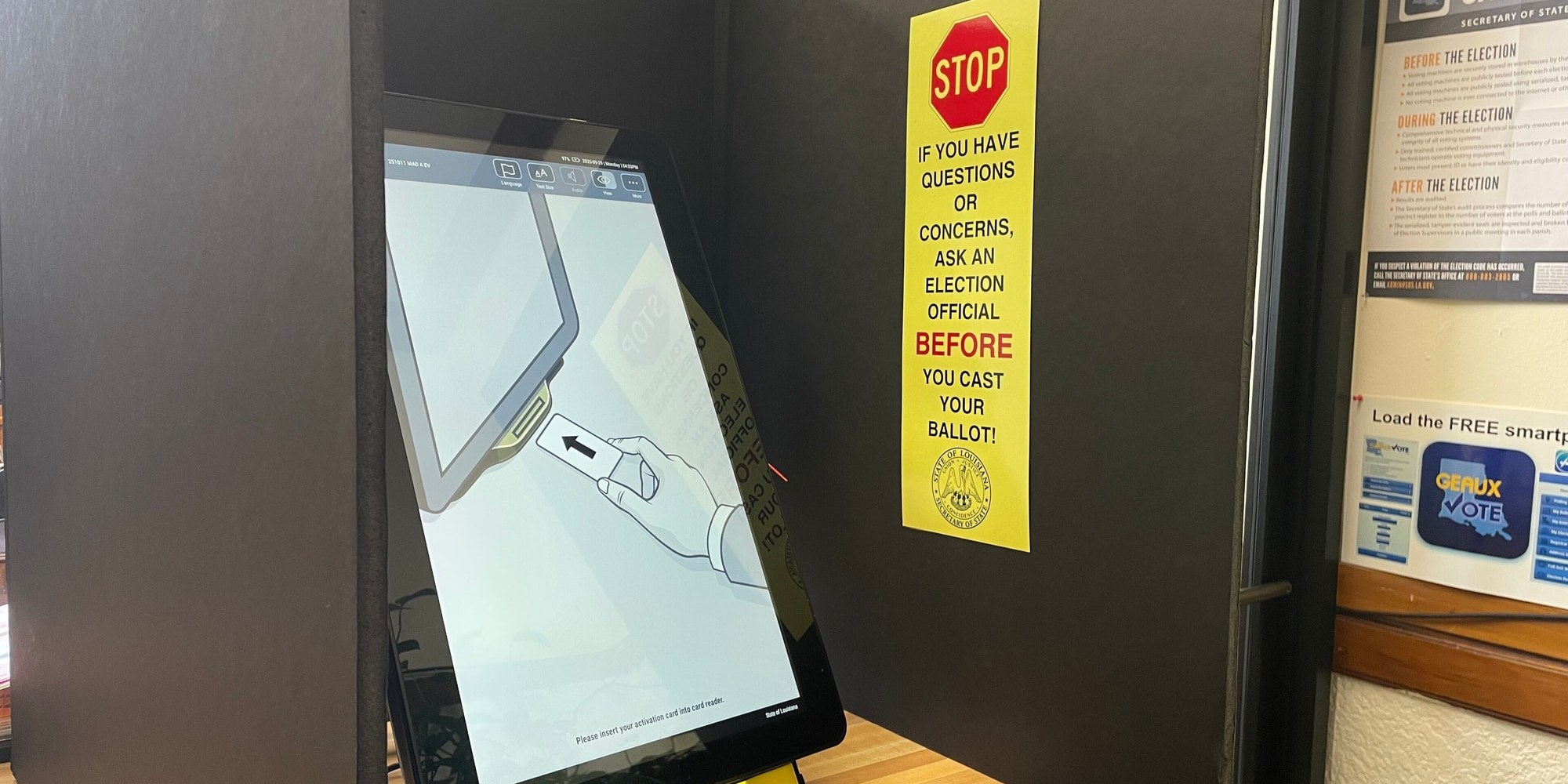
Top: A touchscreen voting machine at the Madison Parish Courthouse in Tallulah, La. Photo: Ktkvtsh (Wikimedia Commons), CC BY 4.0, cropped.
Voting machines have real security problems. That is not a fringe claim. For two decades, university security teams, state-commissioned reviews, federal advisories and national courts have documented weaknesses in the machines and software used to cast and count votes, in the United States and in countries from the Netherlands to India to Brazil.
The record is just as clear on a second point. In the cases below, researchers showed what an attacker could do. No court or official audit among them found that a technical attack actually changed an election result. Both facts belong in any honest discussion of election security, and the research explains why both can be true at once.
The early American studies
In 2006, a Princeton University team that included computer scientists Edward Felten and J. Alex Halderman obtained a Diebold AccuVote-TS, a paperless touchscreen machine then used by more than 10% of registered U.S. voters, including every voter in Maryland and Georgia. In a peer-reviewed paper, they showed that about a minute of access to the machine or its memory card was enough to install software that could steal votes, "modifying all records, logs, and counters" so that everything matched the false total. They also built a virus that could spread from machine to machine through memory cards during normal election handling.
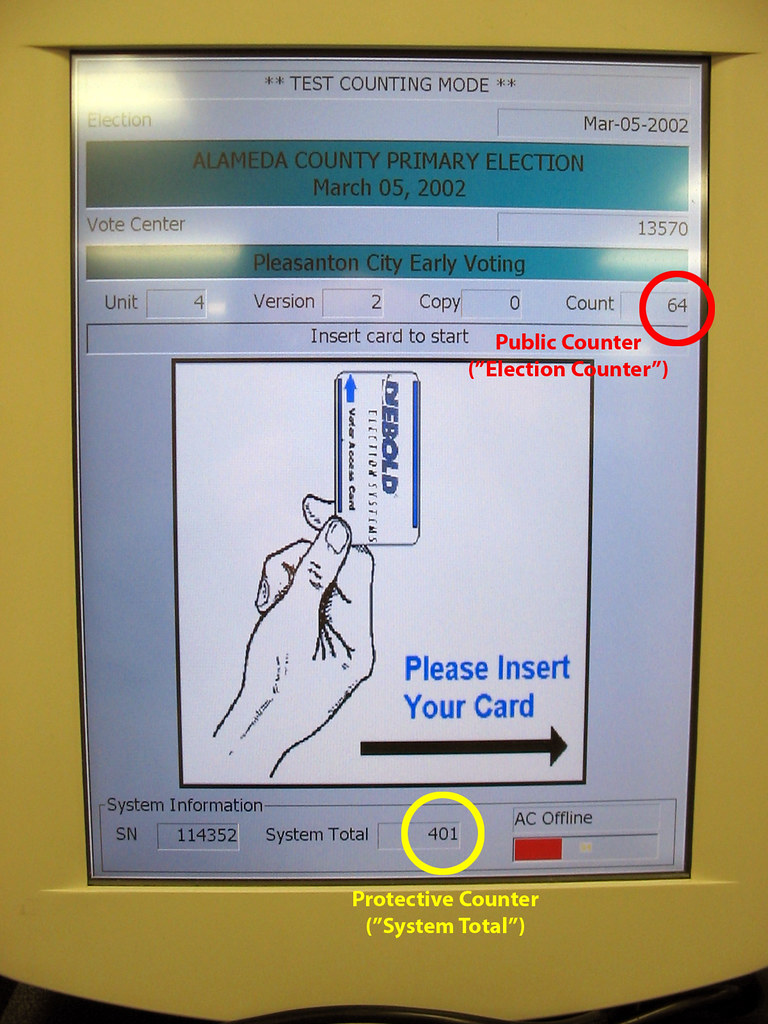
The start screen of a Diebold AccuVote-TS, the paperless touchscreen model Princeton researchers studied in 2006. Photo: Joe Hall (Flickr), CC BY 2.0.
A year later, California's secretary of state hired University of California teams to examine every system certified in the state. Their red team overview concluded that "the technology and security of all three systems could be compromised." The reviewers noted they had not judged how likely such attacks were in practice. The state decertified every reviewed system and then recertified them under strict conditions, limiting some touchscreen models to one per polling place for voters with disabilities.
Ohio's Project EVEREST study, led by researchers from Penn State and the University of Pennsylvania, went further. "All of the studied systems possess critical security failures," the 2007 final report said. Its teams were able to subvert every system they were given.
Newer systems, similar findings
Since 2020, Georgia has used ballot-marking devices statewide for in-person voting. These are touchscreens that print a paper ballot for the voter, which a scanner then counts.
In 2022, the federal Cybersecurity and Infrastructure Security Agency (CISA) issued an advisory listing nine vulnerabilities in the Dominion ImageCast X, the ballot-marking device used across Georgia. Halderman, now at the University of Michigan, and Auburn University's Drew Springall reported the flaws. CISA said exploiting them would require physical access to the devices or similar access, and that it had "no evidence that these vulnerabilities have been exploited in any elections."
Halderman's expert report in a long-running federal lawsuit, Curling v. Raffensperger, went into more detail. He found that attackers could alter the QR codes Georgia's scanners count, install malicious software and forge access cards. "Despite the addition of a paper trail, ICX malware can still change individual votes and most election outcomes without detection," he wrote. He added that a risk-limiting audit, a statistical hand check of paper ballots, could catch outcome-changing fraud, but that Georgia required one for only one contest every two years. In its March 2025 ruling, the court said CISA had "confirmed and validated" his findings and that the plaintiffs had presented "substantial evidence" supporting their security concerns. The court then dismissed the case because the plaintiffs lacked legal standing, without ruling on the merits. An appeal is pending. Halderman has also said publicly that he knows of no evidence the flaws were used to change votes in past elections.
Georgia lawmakers passed a law in 2024 to stop counting ballots by QR code and count the printed text instead. In June 2026 they delayed that change to January 2028, so QR codes were still counted in this month's election.
Not every flaw involves changing votes. In 2024, a Michigan-led team showed that a weakness in some Dominion scanners, used in parts of 21 states, could reveal the order in which ballots were cast, which can threaten ballot secrecy. Dominion released a fix.
The confirmed breaches came from inside
The two confirmed breaches of U.S. election systems after the 2020 election did not come from distant hackers. They came from people who were let inside.
In Mesa County, Colorado, in May 2021, the elected county clerk arranged for an unauthorized person to attend a state software update using an employee's badge. That person made forensic copies of the county's election server, and screenshots with confidential passwords were later posted online. A jury convicted the clerk, and in April 2026 the Colorado Court of Appeals upheld the convictions. The state decertified the equipment, and the county had to replace it.
In Coffee County, Georgia, in January 2021, people without authorization copied the county's election software and data. The federal court in the Curling case called it "a serious security breach," and Halderman testified that because the software was shared with unauthorized people inside and outside the country, it raised the risk to future elections.
Neither breach changed a vote count. Both gave outsiders copies of software that could help them plan attacks later.
Around the world
Netherlands. Researchers showed in 2006 that they could replace the software on the Nedap machines used by about 90% of Dutch voters, and that radio signals from an unmodified machine could reveal how someone voted from several meters away. "We conclude that the Nedap ES3B is unsuitable for use in elections," they wrote. In 2007 the Dutch government withdrew approval for voting machines, and the country returned to paper ballots.
Germany. In 2009, Germany's Federal Constitutional Court ruled that the rules allowing voting machines in the 2005 national election were unconstitutional. Citizens, it said, must be able to check the key steps of an election "without any specialist knowledge." The court did not order a new election, saying there was no indication the machines were faulty or had been manipulated.
Ireland. Ireland spent about €51 million (roughly $59 million) on a Nedap-based system that was used only in pilots in 2002. An independent commission could not recommend its election management software, and in 2009 the government dropped electronic voting.
India. A 2010 study by U.S., Indian and Dutch researchers showed two hardware attacks on India's electronic voting machines, each needing only brief physical access. In 2013, India's Supreme Court called a paper record that voters can see "an indispensable requirement of free and fair elections," and paper slips were rolled out nationwide. In April 2024 the court rejected requests to return to paper ballots, noting that sample checks of those slips had never found a mismatch. It also added safeguards, including letting candidates who finish second or third request an engineering check of 5% of the machines.
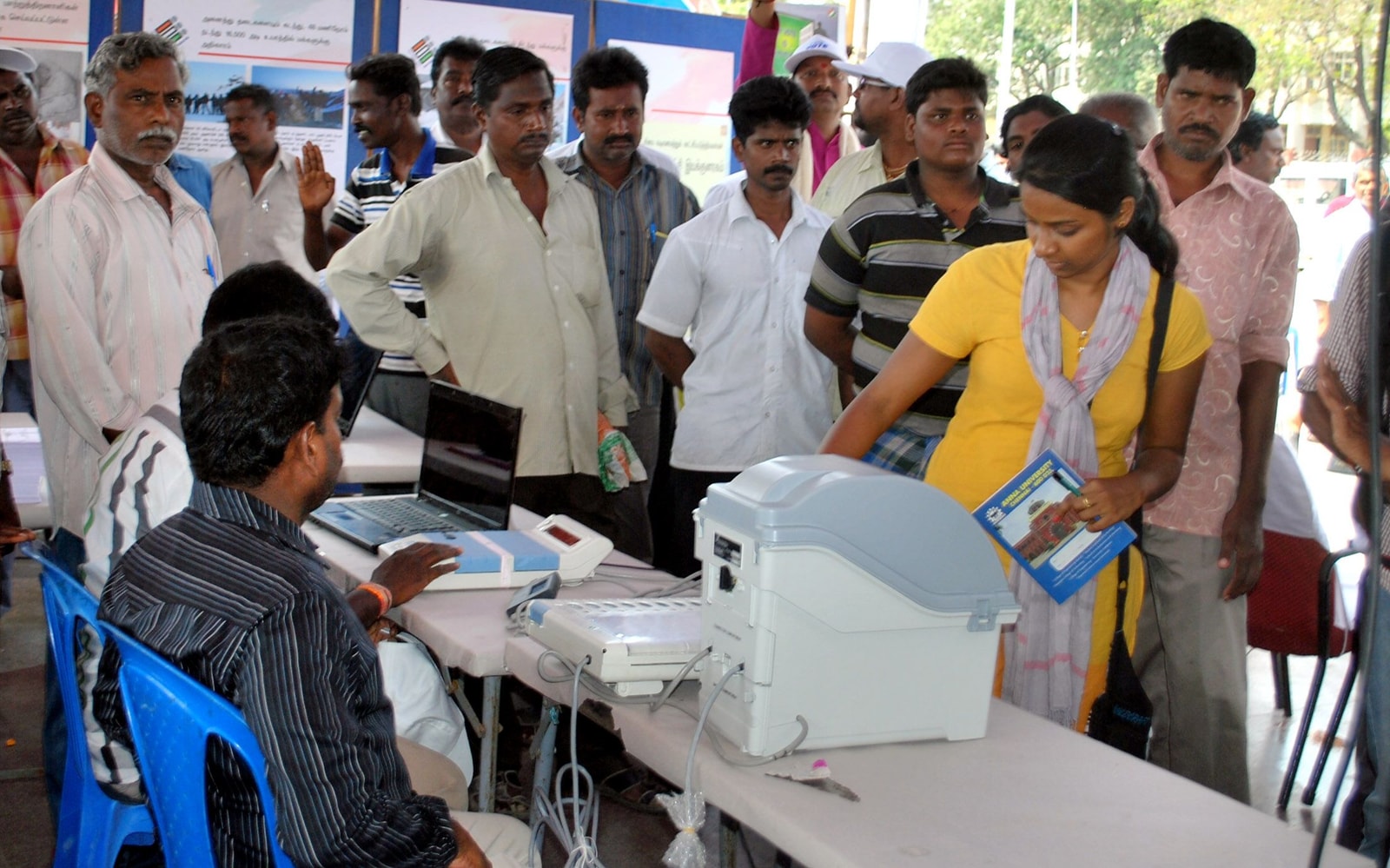
Voters in Chennai watch a 2014 demonstration of India's electronic voting machine and the printer that produces a paper slip voters can check. Photo: Election Commission (GODL-India), via Wikimedia Commons.
Brazil. Brazil's election court invites researchers to attack its machines in public tests. In a 2017 test, a team led by computer scientist Diego Aranha found that the same encryption keys were built into every machine, which let them unlock the software and run their own code. "Injecting code in those libraries opened the possibility of having complete control over the machine," they wrote. The election court changed how it protects its keys, and the researchers confirmed an earlier ballot-secrecy flaw had been fixed.
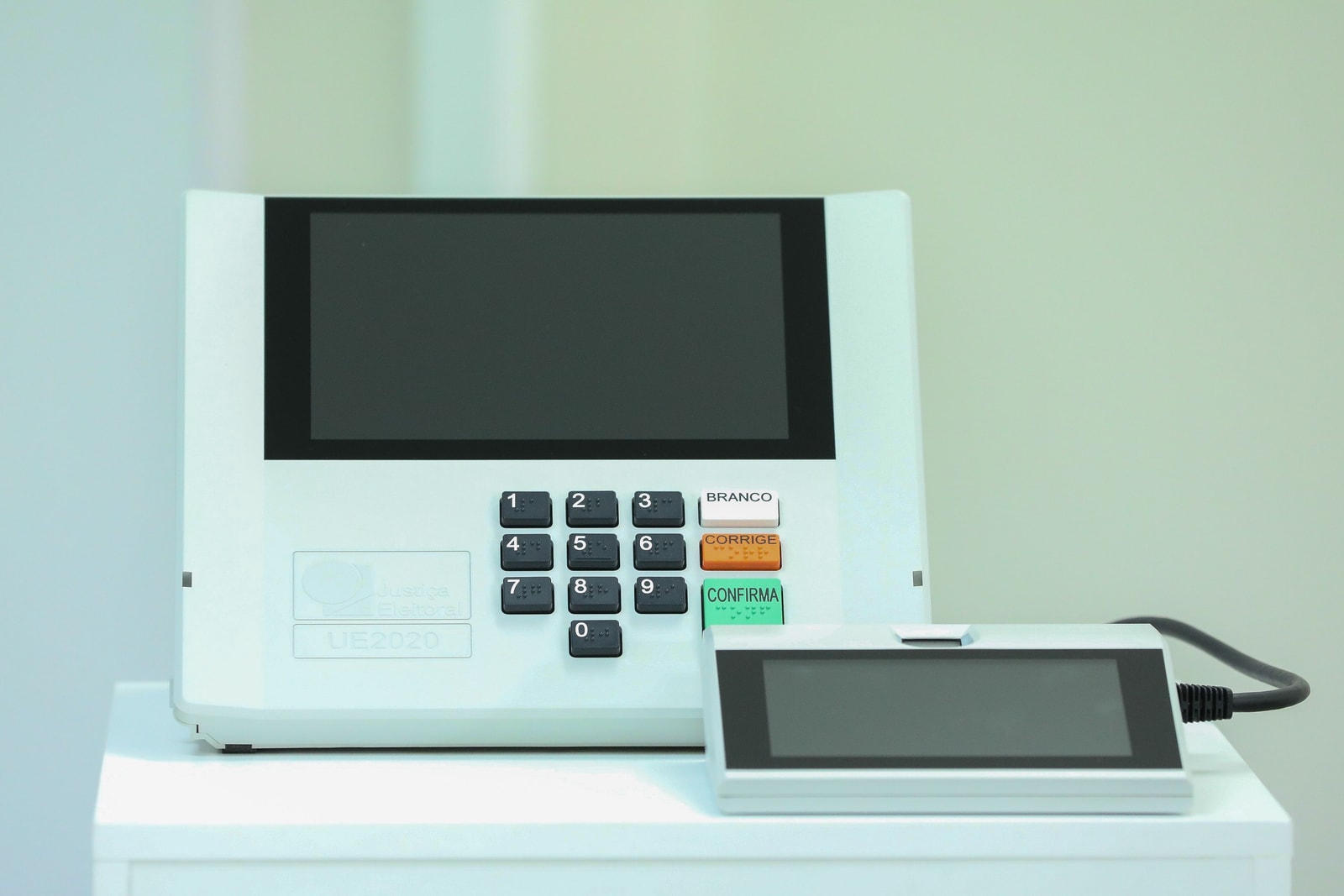
Brazil's UE2020 electronic voting machine. Photo: Antonio Augusto, Secom/TSE (public domain), via Wikimedia Commons.
Internet voting has the weakest record
Voting over the internet adds risks that machines in a polling place do not have.
Estonia, which lets voters cast ballots online, was studied by a team that recommended in 2014 that the country "discontinue the I-voting system." Estonia kept it. In 2023 its Supreme Court rejected a challenge to the online vote but said e-voting "requires consistent attention from the legislator."
Switzerland halted its main online voting system in 2019 after researchers showed its proofs of an honest count could be faked. Trials later resumed under stricter rules. In March 2026, the canton of Basel-Stadt could not decrypt 2,048 online votes, which went uncounted, and it suspended its trial.
New South Wales, Australia, had a flaw in its iVote system during a live 2015 election that could have let attackers read or change votes. About 66,000 votes were cast before it was patched. "While we do not know whether anyone exploited the opportunity for electoral fraud, we know the opportunity was there," the researchers wrote. In 2022, a state court voided three local elections after iVote failed under heavy demand and kept some people from voting.
Moscow published its 2019 online voting code for testing. A researcher recovered the encryption keys "in a matter of minutes." The flaw was fixed before the vote.
What the record does not show
Across this research, the documented harm is exposure and risk. None of the official findings above concludes that a hack decided an election.
After the 2020 U.S. election, Georgia hand-counted about 5 million presidential ballots. The audit confirmed the reported winner. Even that has drawn criticism from inside the research community. University of California, Berkeley statistician Philip Stark, who helped develop risk-limiting audits, argued in 2024 that process errors made Georgia's audit less conclusive than it appeared, writing that "there is no evidence that the reported outcome is wrong, neither is there evidence that it is correct." After the 2024 election, CISA's director said the agency had no evidence of malicious activity that had a material impact on election infrastructure.
Stark's point is the one security researchers make most often. Proving that a machine works requires evidence, not just the absence of known attacks.
What the research says works
The fix researchers keep coming back to is not a better machine. It is a check that does not depend on any machine.
The National Academies of Sciences, Engineering, and Medicine recommended in 2018 that elections use human-readable paper ballots and that states "mandate risk-limiting audits prior to the certification of election results." A risk-limiting audit hand-checks a random sample of paper ballots, adding more until there is strong statistical evidence the reported winner is correct. The academies also said marked ballots should not be returned over the internet.
Paper helps only if it records what the voter chose and someone checks it. In a 2020 study, University of Michigan researchers planted an error on printed ballots in a realistic mock polling place. Only 40% of participants looked at their printout at all, and only 6.6% reported the problem.
What it means for you
If your county uses a ballot-marking device, read your printed ballot before you cast it, and tell a poll worker if anything is wrong. You can also ask your county or state election office two questions: does every voter leave a paper record, and is that paper audited before results are certified?
The weaknesses in voting technology are real and well documented. So is the research on how to catch problems before they matter.
References
Aranha, D. F., Barbosa, P., Cardoso, T. N. C., Lüders, C., & Matias, P. (2018). Execução de código arbitrário na urna eletrônica brasileira. In Anais do XVIII Simpósio Brasileiro em Segurança da Informação e de Sistemas Computacionais. Sociedade Brasileira de Computação. https://sol.sbc.org.br/index.php/sbseg/article/view/4243
Ballotpedia News. (2026, June 29). Georgia enacts legislation extending voting machine deadline, establishing automatic hand recounts. https://news.ballotpedia.org/2026/06/29/georgia-enacts-legislation-extending-voting-machine-deadline-establishing-automatic-hand-recounts/
Basel-Stadt. (2026). E-voting [Canton information page]. https://www.bs.ch/en/node/29299
Bernhard, M., McDonald, A., Meng, H., Hwa, J., Bajaj, N., Chang, K., & Halderman, J. A. (2020). Can voters detect malicious manipulation of ballot marking devices? In 2020 IEEE Symposium on Security and Privacy. IEEE. https://jhalderm.com/pub/papers/bmd-verifiability-sp20.pdf
Bishop, M. (2007). Overview of red team reports [Report for the California Secretary of State Top-to-Bottom Review]. University of California, Davis. https://votingsystems.cdn.sos.ca.gov/oversight/ttbr/red-overview.pdf
Bundesverfassungsgericht. (2009, March 3). Judgment of the Second Senate, 2 BvC 3/07, 2 BvC 4/07. https://www.bundesverfassungsgericht.de/SharedDocs/Entscheidungen/EN/2009/03/cs20090303_2bvc000307en.html
California Secretary of State. (2007, August 3). Secretary of State Debra Bowen moves to strengthen voter confidence in election security following top-to-bottom review of voting systems [Press release]. https://votingsystems.cdn.sos.ca.gov/oversight/ttbr/db07-042-ttbr-system-decisions-release.pdf
Commission on Electronic Voting. (2006). Second report of the Commission on Electronic Voting. Government of Ireland. https://web.archive.org/web/20071119045551/http://www.cev.ie/htm/report/second_report/pdf/Part%207%20Summary%20and%20Conclusions.pdf
Crimmins, B. L., Narayanan, D. Y., Springall, D., & Halderman, J. A. (2024). DVSorder: Ballot randomization flaws threaten voter privacy. In Proceedings of the 33rd USENIX Security Symposium. USENIX Association. https://www.usenix.org/conference/usenixsecurity24/presentation/crimmins
Cybersecurity and Infrastructure Security Agency. (2022, June 3). Vulnerabilities affecting Dominion Voting Systems ImageCast X (ICSA-22-154-01). https://www.cisa.gov/news-events/ics-advisories/icsa-22-154-01
Cybersecurity and Infrastructure Security Agency. (2024, November 6). Statement from CISA Director Easterly on the security of the 2024 elections. https://cisa.gov/news-events/news/statement-cisa-director-easterly-security-2024-elections
Curling v. Raffensperger, No. 1:17-cv-2989-AT (N.D. Ga. Mar. 31, 2025). https://www.courthousenews.com/wp-content/uploads/2025/04/curling-v-raffensperger-order-dismiss-usdc-northern-georgia.pdf
Feldman, A. J., Halderman, J. A., & Felten, E. W. (2007). Security analysis of the Diebold AccuVote-TS voting machine. In Proceedings of the 2007 USENIX/ACCURATE Electronic Voting Technology Workshop. USENIX Association. https://www.usenix.org/legacy/event/evt07/tech/full_papers/feldman/feldman.pdf
Gaudry, P., & Golovnev, A. (2020). Breaking the encryption scheme of the Moscow internet voting system. In Financial Cryptography and Data Security 2020. Springer. https://arxiv.org/abs/1908.05127
Georgia Secretary of State. (2020, November 19). Risk-limiting audit report: Georgia presidential contest, November 2020 [Memo]. https://nowhabersham.com/wp-content/uploads/2020/11/Risk_Limiting_Audit_Report_Memo_11-19-2020.pdf
Gonggrijp, R., & Hengeveld, W.-J. (2007). Studying the Nedap/Groenendaal ES3B voting computer: A computer security perspective. In Proceedings of the USENIX/ACCURATE Electronic Voting Technology Workshop. USENIX Association. https://www.usenix.org/legacy/event/evt07/tech/full_papers/gonggrijp/gonggrijp.pdf
Halderman, J. A. (2023). Security analysis of Georgia's ImageCast X ballot marking devices (Redacted expert report dated July 1, 2021). Filed in Curling v. Raffensperger, No. 1:17-cv-2989-AT (N.D. Ga.), Doc. 1681. https://storage.courtlistener.com/recap/gov.uscourts.gand.240678/gov.uscourts.gand.240678.1681.0_2.pdf
Halderman, J. A. (2023, June 14). Security analysis of the Dominion ImageCast X. CITP Blog, Princeton University. https://blog.citp.princeton.edu/?p=17089
Halderman, J. A., & Teague, V. (2015). The New South Wales iVote system: Security failures and verification flaws in a live online election. In E-Voting and Identity: VoteID 2015. Springer. https://arxiv.org/abs/1504.05646
Lewis, S. J., Pereira, O., & Teague, V. (2019). How not to prove your election outcome [Technical report]. https://sarahjamielewis.com/evoting/HowNotToProveElectionOutcome.pdf
McDaniel, P., Blaze, M., Vigna, G., et al. (2007). EVEREST: Evaluation and validation of election-related equipment, standards and testing. Final report. Ohio Secretary of State. https://www.eac.gov/sites/default/files/eac_assets/1/28/EVEREST.pdf
National Academies of Sciences, Engineering, and Medicine. (2018). Securing the vote: Protecting American democracy. The National Academies Press. https://doi.org/10.17226/25120
NSW Electoral Commissioner v Kempsey Shire Council (No 2) [2022] NSWSC 282. https://www.caselaw.nsw.gov.au/decision/17f913a39e2ade551b821020
People v. Peters, 2026 COA 24 (Colo. App. Apr. 2, 2026). https://www.coloradojudicial.gov/system/files/opinions-2026-04/24CA1951-PD.pdf
Springall, D., Finkenauer, T., Durumeric, Z., Kitcat, J., Hursti, H., MacAlpine, M., & Halderman, J. A. (2014). Security analysis of the Estonian internet voting system. In Proceedings of the 2014 ACM SIGSAC Conference on Computer and Communications Security. ACM. https://jhalderm.com/pub/papers/ivoting-ccs14.pdf
Stark, P. B. (2024). When audits and recounts distract from election integrity: The 2020 U.S. presidential election in Georgia. In Proceedings of E-Vote-ID 2024. https://arxiv.org/abs/2408.00055
Supreme Court of India. (2024, April 26). Association for Democratic Reforms v. Election Commission of India, 2024 INSC 341. https://www.scobserver.in/wp-content/uploads/2024/04/VVPAT-EVM-Judgement-Supreme-Court.pdf
Tweede Kamer der Staten-Generaal. (2007). Brief van de Staatssecretaris van Binnenlandse Zaken en Koninkrijksrelaties (Kamerstuk 31 200 VII, nr. 5). https://zoek.officielebekendmakingen.nl/kst-31200-VII-5.pdf
Wolchok, S., Wustrow, E., Halderman, J. A., Prasad, H. K., Kankipati, A., Sakhamuri, S. K., Yagati, V., & Gonggrijp, R. (2010). Security analysis of India's electronic voting machines. In Proceedings of the 17th ACM Conference on Computer and Communications Security. ACM. https://indiaevm.org/evm_tr2010-jul29.pdf