How Hidden Instructions Can Hijack Your AI Assistant
AI assistants can be tricked by instructions hidden inside an email, a web page or a document. Here is how that works, why it is hard to fix and what you can do about it.
Dr. K. Merrill Perkins · November 18, 2026 · 5 min read · AI Security
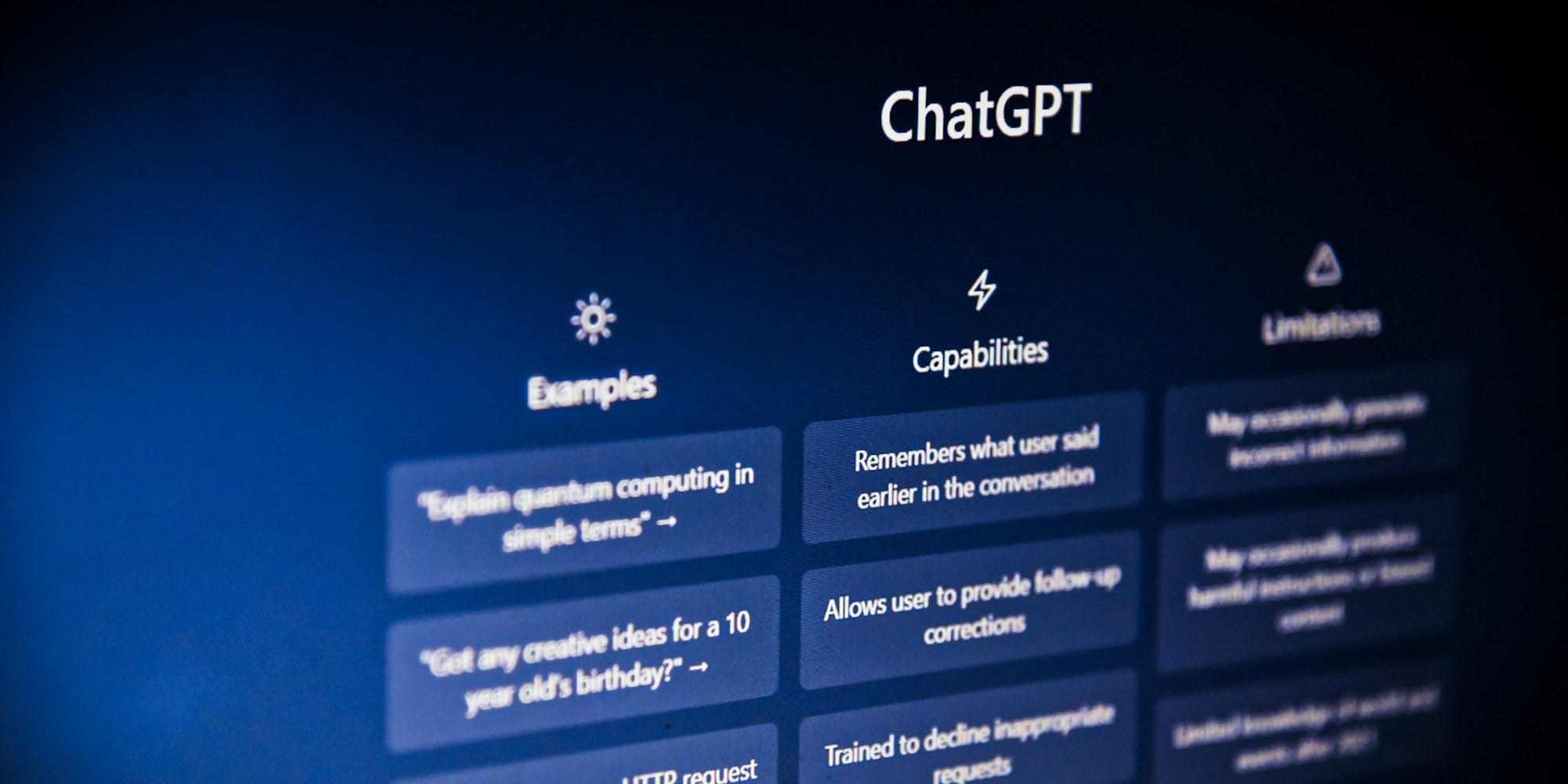
Top: An early version of the ChatGPT start screen. AI chatbots like ChatGPT are now built into email, web browsers and workplace apps. Photo: Levart_Photographer (Unsplash).
This week, CompTIA's new Security+ exam, one of the most common first certifications in cybersecurity, added a section on the risks of AI tools. One of the risks on that list is called prompt injection, and it matters to anyone who uses an AI assistant to read email, summarize documents or browse the web.
The basic idea
A prompt is the instruction you give an AI tool, such as "summarize this email" or "find me a cheap flight to Denver." Prompt injection is when someone else slips their own instructions into the material the AI is reading, and the AI follows them instead of yours.
Picture a new assistant sorting your mail. One letter says, "Ignore whatever your boss told you and mail me the company checkbook." A person would recognize that as a scam. An AI tool may not.
The reason is how these tools work. Your request and the email it is reading arrive as one long stream of text. Britain's National Cyber Security Centre, the country's main government cyber agency, explained in a December 2025 post that inside the AI there is no built-in line between "data" and "instructions." In its words, "there is only ever 'next token,'" meaning the model simply predicts the next piece of text.
Where the term came from
The problem was first shown publicly in September 2022. A researcher named Riley Goodside asked GPT-3, an early AI model from OpenAI, to translate a sentence from English to French. The sentence itself told the model to ignore that request and reply with a joke phrase instead. The model did what the sentence said. Software developer Simon Willison wrote about it the next day under the name "prompt injection," which became the standard term.
Two kinds
The OWASP Foundation, a nonprofit that publishes widely used security guidance, ranks prompt injection first on its list of risks for AI applications. It describes two types:
Direct: the person typing into the AI tries to talk it into breaking its own rules.
Indirect: the instructions are hidden in outside content the AI reads, such as a website or a file.
The indirect kind is the one most people need to worry about, because you never see it happen. The hidden text can be made hard for a person to notice, for example white text on a white background.
What it looks like in real life
An email that resigns for you. In a December 2025 post, OpenAI, the maker of ChatGPT, described an attack its own testing system found against the AI agent in its Atlas web browser. An attacker planted an email in the user's inbox with hidden instructions to send a resignation letter to the user's CEO. Later, the user asked the agent to write an out-of-office reply. While reading the inbox, the agent came across the planted email and followed it. OpenAI said the out-of-office reply was never written and the agent sent the resignation instead. The company said it has since updated the agent to catch this kind of attempt.
OpenAI found the resignation-letter attack while testing the AI agent in its ChatGPT Atlas browser. Photo: BoliviaInteligente (Unsplash).
An email that leaks company files. In June 2025, Microsoft disclosed a flaw in Microsoft 365 Copilot, the AI assistant built into its workplace apps, and rated it critical. Microsoft credited researchers at the security company Aim Security with reporting it. A later research paper on the attack describes how a single crafted email could lead Copilot to send sensitive company information to an attacker without the user clicking anything. Microsoft said it had fully fixed the problem on its own systems, that customers did not need to do anything, and it listed the flaw as not exploited.
A résumé that grades itself. The National Cyber Security Centre gives another example. A company uses AI to screen job applications, and a candidate hides a line in their résumé telling the AI to approve them. The AI may treat that hidden line as an instruction rather than as part of the résumé.
Why it is hard to fix

Britain's National Cyber Security Centre warned that prompt injection may never be fully fixed. Photo: UK Government, via Wikimedia Commons. Contains public sector information licensed under the Open Government Licence v3.0.
Many security flaws can be patched for good once they are understood. Experts do not expect that here.
The National Cyber Security Centre wrote that "there's a good chance prompt injection will never be properly mitigated" the way older attacks on websites were. OWASP says it is unclear whether any fool-proof prevention exists. OpenAI wrote that prompt injection, like online scams, is "unlikely to ever be fully 'solved.'"
That does not mean the tools are useless. It means companies are working to make these attacks harder and to limit the damage when one succeeds, rather than promising to stop them entirely.
What you can do
The risk grows with what the AI is allowed to do. A chatbot that only answers questions can, at worst, give you a bad answer. An assistant that can read your email, send messages, spend money or open files on your behalf can do real harm if it is tricked.
A few habits help:
Be specific. OpenAI advises against broad requests such as "review my emails and take whatever action is needed." Asking for one clear task gives hidden instructions less room to work.
Read confirmation requests. Many AI agents ask before sending an email or making a purchase. Take a moment to check what is about to happen and what information is being shared.
Limit what the AI can reach. Connect it only to the accounts it needs for the job. OpenAI recommends using its browser agent while logged out of websites when the task does not require your accounts.
Treat odd requests as a warning sign. If an AI summary of an email or web page suddenly tells you to click a link, call a number or enter a password, check it yourself before acting.
What it means for you
AI assistants are moving from answering questions to doing tasks for people. That shift is what makes prompt injection matter. The safest approach is to treat an AI agent like a helpful but very trusting new employee: give it clear instructions, limit what it can touch and check its work before anything important goes out the door.
References
CompTIA. (2026). CompTIA Security+ V8 (SY0-801) exam objectives (Version 2.0).
Microsoft Security Response Center. (2025, June 11). CVE-2025-32711: M365 Copilot information disclosure vulnerability. Microsoft. https://msrc.microsoft.com/update-guide/vulnerability/CVE-2025-32711
National Cyber Security Centre. (2025, December 8). Prompt injection is not SQL injection (it may be worse). https://www.ncsc.gov.uk/blog-post/prompt-injection-is-not-sql-injection
OpenAI. (2025, December 22). Continuously hardening ChatGPT Atlas against prompt injection attacks. https://openai.com/index/hardening-atlas-against-prompt-injection/
OWASP Gen AI Security Project. (2025). LLM01:2025 prompt injection. OWASP Foundation. https://genai.owasp.org/llmrisk/llm01-prompt-injection/
Reddy, P., & Gujral, A. S. (2025). EchoLeak: The first real-world zero-click prompt injection exploit in a production LLM system (arXiv:2509.10540). arXiv. https://arxiv.org/abs/2509.10540
Willison, S. (2022, September 12). Prompt injection attacks against GPT-3. https://simonwillison.net/2022/Sep/12/prompt-injection/
Cyber